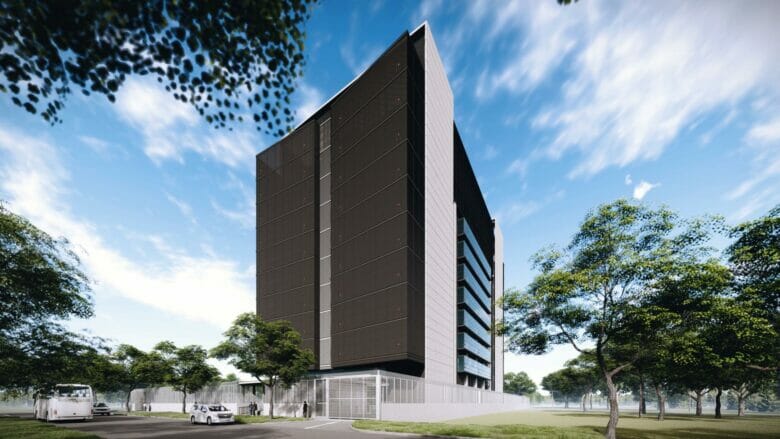
Equinix completed an expansion of its fifth Singapore data centre in April.
Data centre operators eager to serve Singapore’s growing tech sector received some good news this week as the city-state formally reopened applications for the energy-hungry facilities after a three-year hiatus. However, only the efficient and green need apply for the pilot program restarting data centre development in the city.
The city-state’s Economic Development Board (EDB) and Infocomm Media Development Authority (IMDA) said in a joint announcement on Wednesday that they will be accepting applications for new data centre development projects until 21 November, while setting out guidelines aimed at restricting power consumption and limiting environmental impact.
The application process, which formally reopens the sector some three years after Singapore froze construction of new facilities in 2019 over power consumption concerns, requires applying operators to demonstrate how they will offset carbon emissions from their facilities through development of renewable energy, while also asking applicants to show how their proposals would support the city-state’s status as a technology hub and help it achieve its economic objectives.
Delivering some more welcome news in a closed-door session introducing the process to more than 30 operators on Wednesday, officials from the regulators indicated that Singapore may expand the total capacity to be awarded beyond the 60 MW maximum planned earlier, while also expanding the maximum power lease terms from 10 to 30 years, according to James Murphy, managing director for Asia Pacific at data centre consulting firm DC Byte who was briefed on the proceedings but did not attend.
Efficiency Required
Applicants selected for the pilot program will need to receive a platinum certification for their proposed facilities, or expansions to existing facilities, under Singapore’s existing BCA-IMDA Green Mark for New Data Centre (“GM-NDC”) criteria for efficient digital infrastructure, while also demonstrating their ability to design, build and operate the property at a power usage effectiveness ratio (PUE) of 1.3 or better at 100 percent IT load.

Yee May Leong of Equinix
The EDB and IMDA said the pilot program should help the industry to grow sustainably and without straining Singapore’s energy grid. Data centres used an estimated 7 percent of Singapore’s energy supply in 2020.
To promote decarbonisation, the process asks applicants to explain their plans for implementing renewable energy and how they will invest in energy solutions including hydrogen and photovoltaics to offset the facility’s carbon footprint.
Competitive Market
With the city growing as a tech hub and becoming a top location for hyperscale users and cloud providers, the government is gradually reopening development with some of the world’s largest data centre developers expected to apply to open new facilities in the city-state.
US co-location specialist Equinix, which currently operates five facilities, in Singapore expressed a favourable impression of the pilot program when asked if the company plans to submit a proposal.
“Singapore has always been a key market for Equinix, said Yee May Leong, the company’s South Asia managing director. “It would be a privilege for Equinix to partner with the Singapore government as the nation works to build a vibrant, sustainable digital economy.”
DC Byte’s Murphy said he expects 15 to 20 bids to be submitted from a wide range of industry players after the Wednesday meeting drew attendees from local and international operators as well as hyperscalers from China and the US.
“It has been received well by the potential bidders and I think there’s likely to be a flurry of activity,” Murphy told Mingtiandi on Thursday. “Given the fact that there were over 30 operators and hyperscalers in attendance at the meeting, I think we are likely to see an extremely competitive process.”
The pilot program, which was promised when Singapore first moved to lift a total moratorium in January of this year, requires operators to propose a capacity of at least 10 megawatts.
Longer Leases, More Capacity
The potential for longer leases and greater capacity explained at the meeting has caught the attention of operators, at the same time that the efficiency requirements throw down a challenge to the industry.
For Equinix’ Leong, “the increased capacity is beneficial, especially for larger data centres that use advanced cooling systems, due to economies of scale.” She added that, “As investments and expenditure for data centers are capital-intensive, the longer leases would ensure a return-on-investment (ROI) for us, giving us that security and longevity of operations.”
Colliers’ research head for Singapore Catherine He said the availability of more capacity will likely attract more applicants, but added that the increase in scale, coupled with stringent sustainability requirements may also require larger capital investments as well.
“This policy update has also shown that the government is cognizant of the need for additional capacity for Singapore to remain a data centre and technology hub,” He said. “The new regulations with sustainability at the forefront will achieve the best of both worlds by minimizing the carbon footprint of the data centre sector, while ensuring that the sector can operate and grow in a sustainable manner.”
Supply Pipeline
While DC Byte’s Murphy expects the 60 megawatt additional supply to only come online around 2025, he said there is still a pipeline of data centre projects under construction that are expected to increase the sector’s capacity in the next six months.
The restrictions on development of Singapore’s digital infrastructure will likely drive the growth of data centre markets in emerging economies like Philippines, Indonesia, Vietnam and Thailand, he added.
A reported published by Colliers last month showed that there are currently 40 data centre operators in the Lion City led by US-based Digital Realty, which accounts for 16.6 percent of the sector’s total power capacity, followed by state-backed firms ST Telemedia and Singapore Telecommunications.
The property agency expects the city-state’s current supply of around 1,000 megawatts as expanding by 20 percent by the end of 2023 with the lifting of the moratorium and the introduction of new facilities from the current pipeline.
Due to constrained supply and rising energy costs, Colliers expects rents in Singapore data centres will rise by an average of three percent annually with retail colocation leases estimated to book the steepest increases.
Leave a Reply